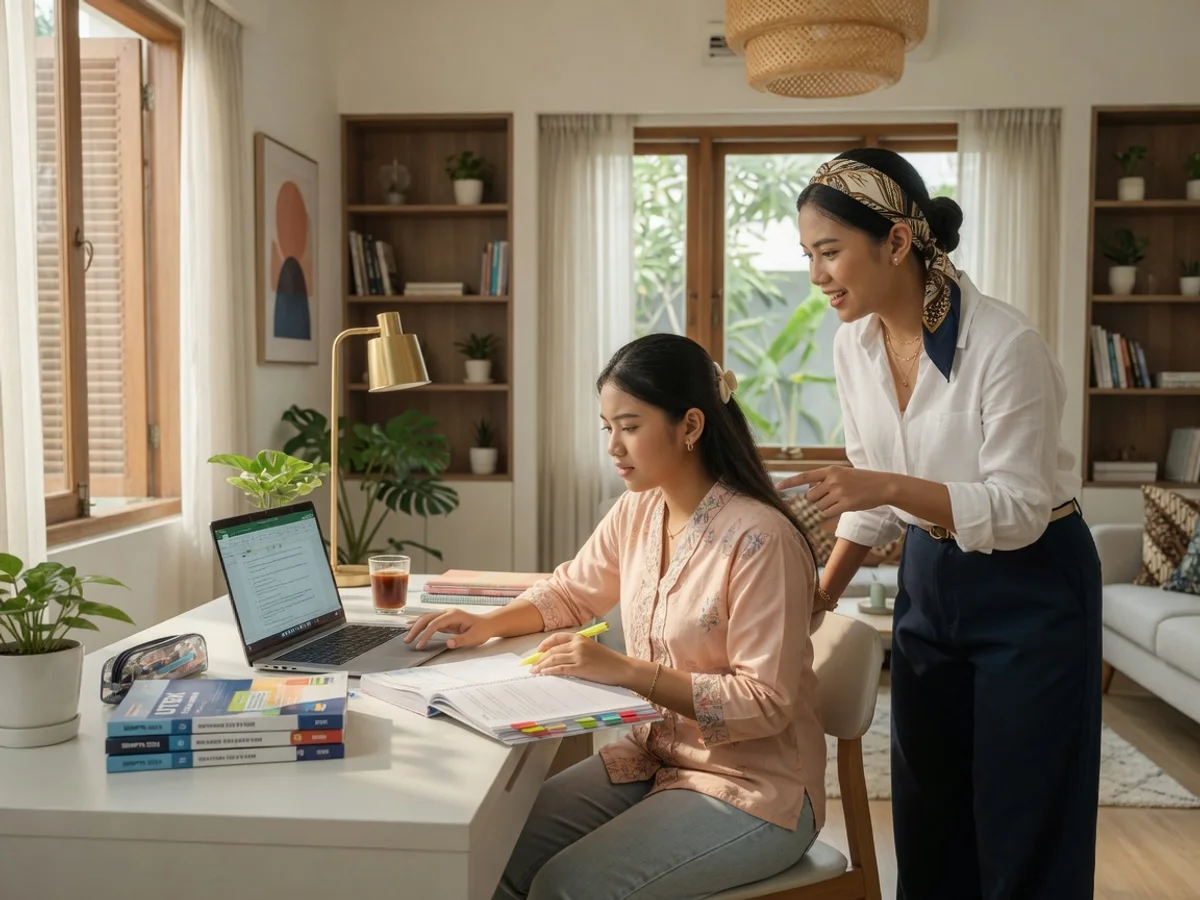
We ask which syllabus you are on, or which paper already has a date on it, before anyone is assigned. The same question fits a ป.4 workbook, a ม.6 counting down to TCAS, and a ก.พ. paper sat years after school. Then one tutor comes to you, or teaches on screen in the weeks when the traffic decides otherwise.

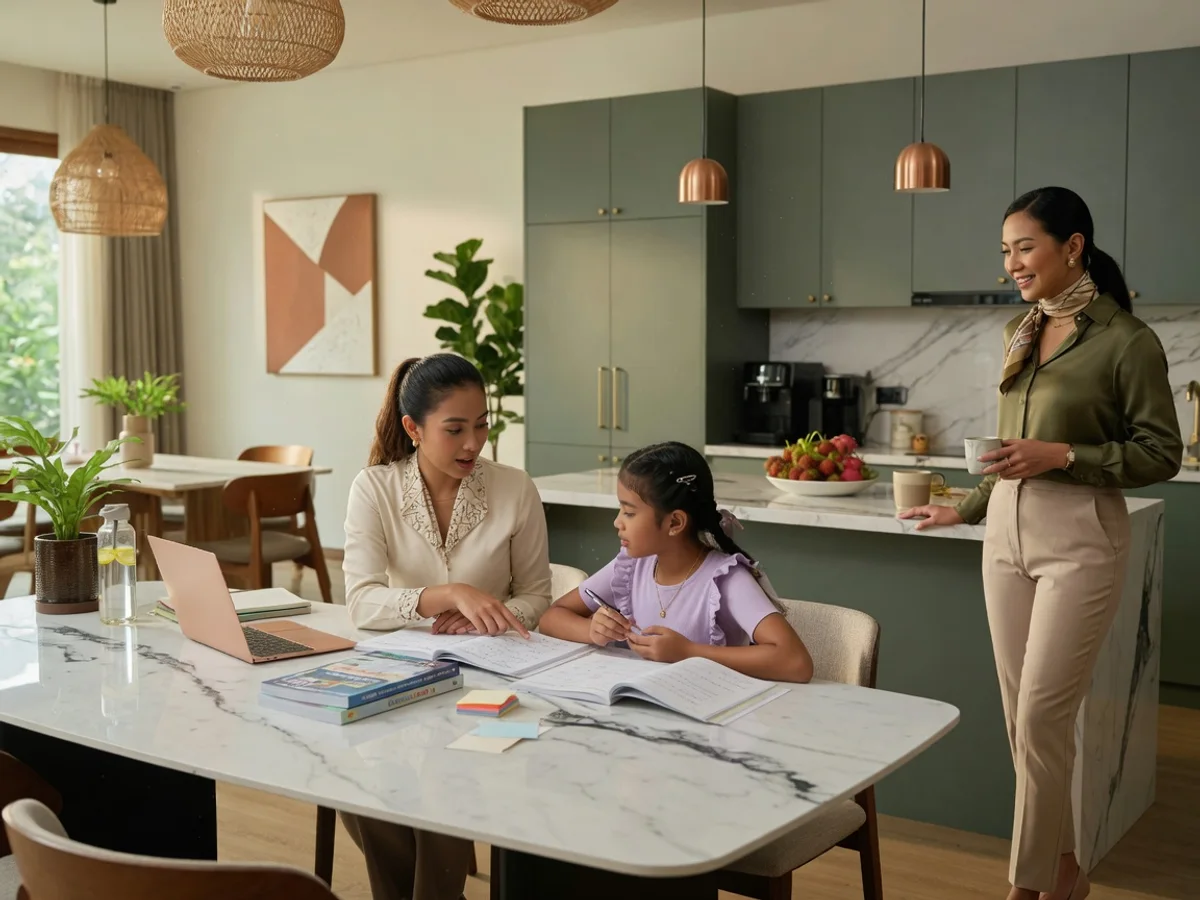
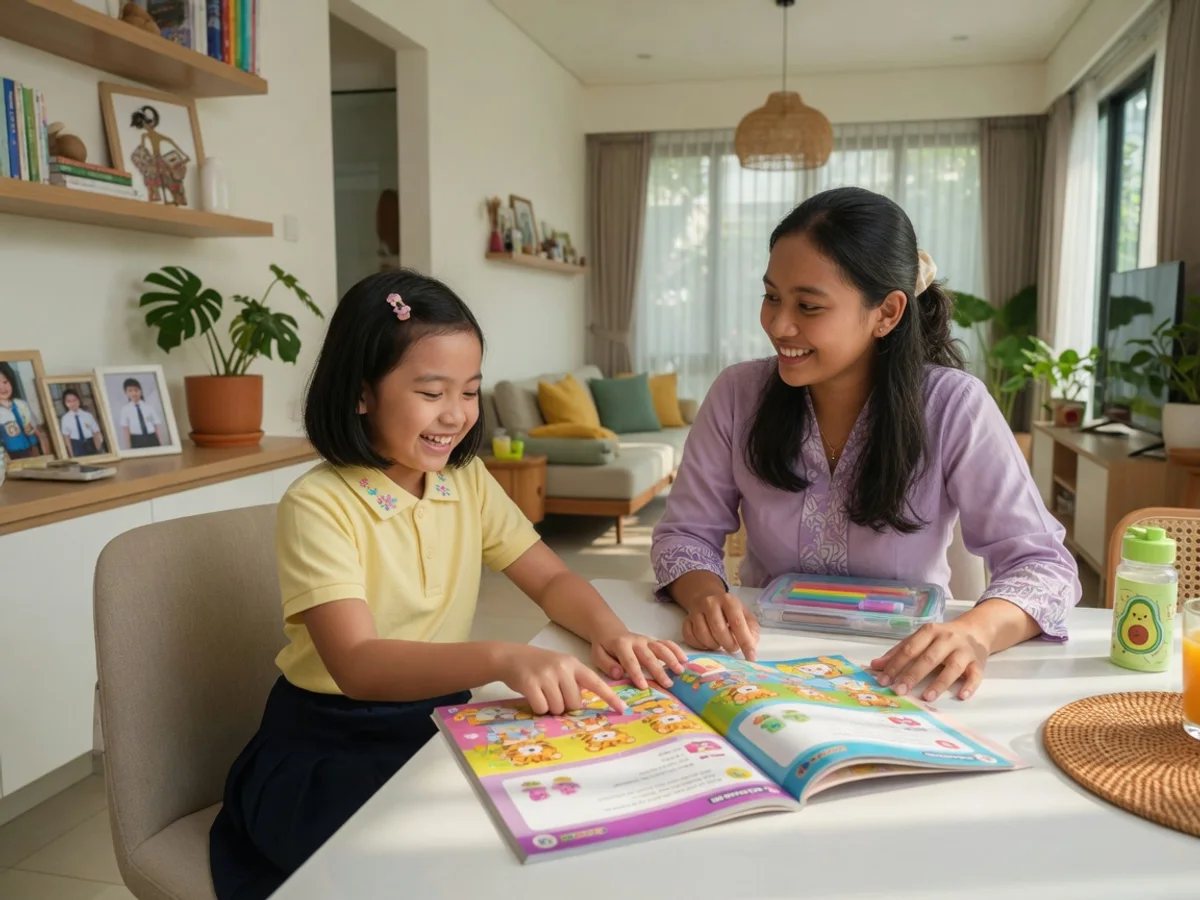
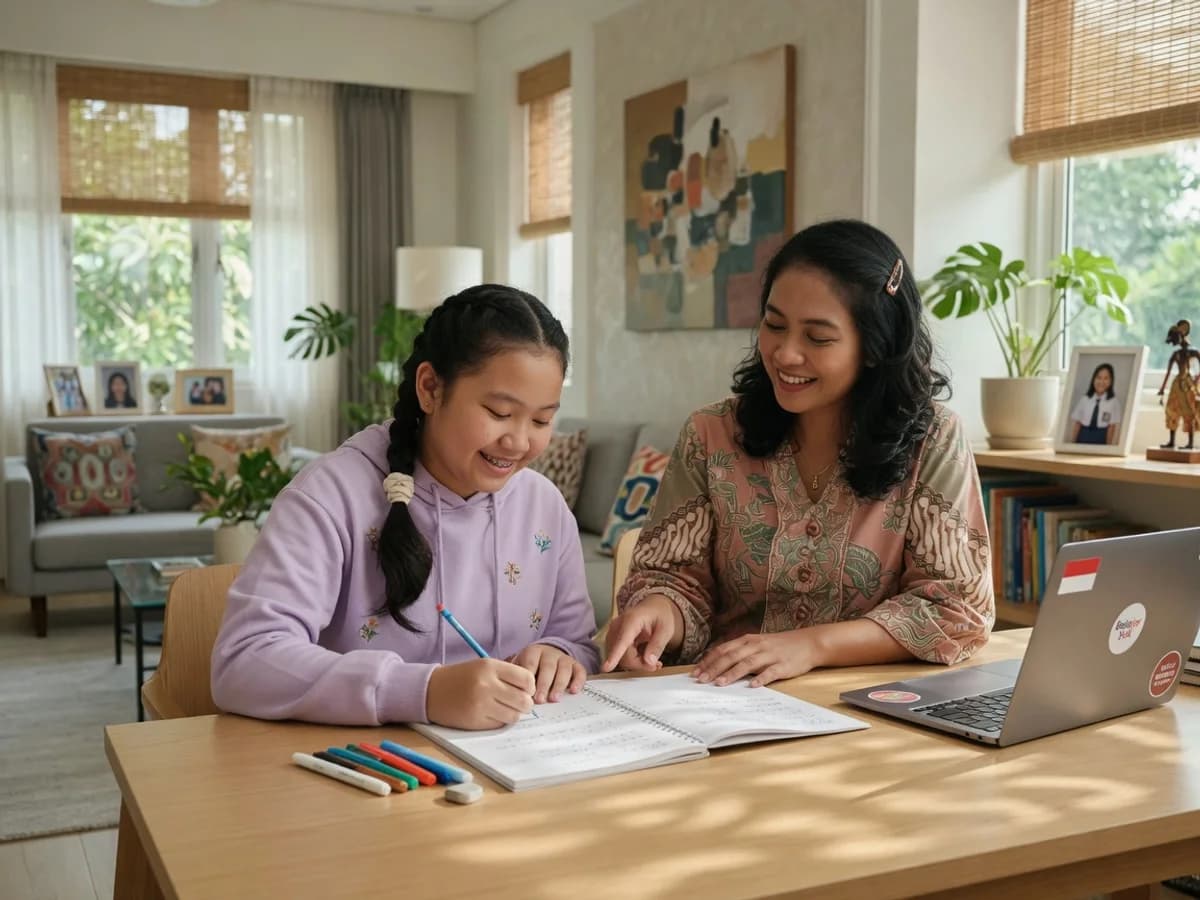
Private tutoring is one tutor teaching one student, at a time and a place the student picks. In Bangkok that usually means the tutor travels: to the dining table, to a quiet corner of the condo, to the school library after the last bell, to a café table near the office before a late shift. What gets taught follows the syllabus the student is actually on. At an international school that is IB, IGCSE, Cambridge A-Level or AP, worked against the board and syllabus that school actually issues. At a national school it is the 2551 core curriculum, O-NET at ป.6, ม.3 and ม.6, and TCAS after that. Where school is already years behind the reader, the work follows the paper instead: ก.พ. ภาค ก, the IELTS band a university or an employer asked for, the first-year statistics subject that stopped making sense in week three. In a week where the traffic leaves no room for a journey, the same tutor teaches the same plan on screen.
Four situations that bring people to this page, and what one to one does about each
Four steps, and the first one is a question
The school and its curriculum, or the exam that already has a date: O-NET, TCAS, IGCSE, Cambridge A-Level, ก.พ. ภาค ก, IELTS.
One name, the reason that person was chosen, and the hours they can genuinely hold through the whole term.
At your table or on screen. The tutor asks the student to work through it out loud, then writes down what that showed.
A short written note after every session. It goes to whoever booked the sessions.
Grouped by the paper that has a date on it, from ป.6 up to the ones that arrive years after school
Mathematics AA and AI, the sciences and Economics, plus the Extended Essay and Theory of Knowledge that most agencies here leave alone.
90 minutes per session
Ask about thisMaths, Additional Maths and the separate sciences, worked against the board your school actually entered you for.
90 minutes per session
Ask about thisEvery Edulom tutoring programme, grouped by category. All of them are taught one to one, at your address or online.
One-to-one tutoring in Thailand means one tutor teaching one student, at the family table or over video, on the syllabus that student's school actually uses. Because two school systems run side by side in the same city here, the first question is never the subject. It is which school, and which curriculum.
Five things are settled before anyone is assigned: the school and its curriculum, the year group, the examination that already has a date on it, the language the student works in during lessons, and where the sessions will happen. One tutor is then proposed, together with the reason that person was chosen. A list of profiles to sift through moves the work in the wrong direction.
Three readers book this and they arrive by different doors. A household with a child in ป.4 whose reading has stopped carrying the maths. A ม.6 in the months before TCAS, counting sessions backwards from a date that will not move. And an adult who wants an hour at their own table after work, for ก.พ. ภาค ก, for an IELTS band an employer asked for, or for the first-year university subject that stopped making sense in week three. The method below is the same for all three. What changes is which hours of the day are free, and who the written notes are addressed to.
The first session is a diagnosis. The tutor reads the real evidence first, the exercise books, a marked paper, the school's scheme of work, then asks the student to do rather than to listen. What comes out of it is a short, written picture: what the student can do unaided, what they can do with one prompt, and what is missing altogether. The plan that follows names what gets fixed first and why.
Three honest ways to buy tutoring in Thailand, whether the student is in ป.4 or sitting ก.พ. after work. They solve different problems, and the price alone decides nothing.
| One to one | Two to four sharing | กวดวิชา class | |
|---|---|---|---|
| What the lesson is built around | The gaps in one person’s work | What the two to four already have in common | A syllabus fixed before term starts |
| Who sets the pace | The student | The slowest in the group, by necessity | The timetable |
| A question halfway through | Answered when it is asked | Answered if the others need it too | Usually held to the end, if there is time |
| Which syllabus it can follow | Whichever ladder you are on: ป.6 to ม.6, IGCSE through IB DP and Cambridge A-Level, or a paper with no ladder behind it at all, such as ก.พ. ภาค ก | One ladder at a time, shared by the group | The one the centre has enrolled for |
| Where it happens | Your home in Bangkok, or online | One household hosts, or online | You travel to the centre |
| Scheduling | Around school, activities, exam season, or a shift pattern |
What is decided before the first session, and what happens after it
A tutor travels to the condo or the house, or the session runs over video. In Bangkok that choice is mostly about the hour before the lesson.
One-to-one by default. Two to four students who already know each other can share a tutor. The pace changes; the attention each one gets does not.
The Thai school year opens in mid-May and closes in March; Bangkok international schools run August to June. Sessions are planned against the calendar you are actually on, and against a working year for a reader who has left both behind.
Thai rates are still being set, so there is no figure on this page. What there is instead is the thing a rate card never tells you: what the number is built from, so you can read any quote you are handed.
Published Bangkok rate cards are written per hour, with the tutor’s journey across the city already inside that hourly rate and a minimum of two hours on a visit to your home. Edulom quotes the whole session, so the figure you agree to covers the lesson from arrival to the end. Two quotes only become comparable once you know which unit each one is in.
Thailand runs two school systems alongside each other, and a tutor who is fluent in one does not automatically know the other.
The answers we would give you on the phone, written down.
Tell us the subject and the year, or the paper and its date, and we will take it from there. At your address or online, whichever suits the week.
The UK qualification taught in international schools here. We keep it clearly apart from A-Level TCAS, which is a different exam that happens to share the name.
90 minutes per session
Ask about thisAdvanced Placement subjects and the SAT, for families whose applications are going to universities in the United States.
90 minutes per session
Ask about thisTGAT1 to 3, TPAT1 run by กสพท for medicine, TPAT3 for science and engineering, and A-Level TCAS by subject code. This cycle is back on paper throughout.
120 minutes per session
Ask about thisป.1 to ม.6 across the 2551 core curriculum, and O-NET at ป.6, ม.3 and ม.6, taught in the language the paper is written in.
60 to 90 minutes per session
Ask about thisFrom EAL support for a child who has just changed schools, to the band an international programme or an employer asks for, which adults sit as often as school students do.
60 to 90 minutes per session
Ask about thisFor a family that has just arrived, and for a child who has Thai language and culture sitting on an international school timetable.
60 minutes per session
Ask about thisThe civil-service general-ability paper run by สำนักงาน ก.พ., sat on paper or as an e-Exam, alongside first-year university subjects and the academic writing that arrives with them.
90 to 120 minutes per session
Ask about thisNothing on this page rests on a number about us. Edulom is opening in Thailand, so there is no student count to quote and no rating to show. What can be described honestly is the method: how a tutor is screened, what the first session produces, what reaches you after every session, and what happens when a match turns out to be wrong.

The Thai national ladder runs อนุบาล for ages three to five, then ประถมศึกษา from ป.1 to ป.6, then มัธยมศึกษาตอนต้น from ม.1 to ม.3, and มัธยมศึกษาตอนปลาย from ม.4 to ม.6. Nine of those years are compulsory, from ป.1 to ม.3, and fifteen are free of charge from kindergarten to ม.6. The content follows the Basic Education Core Curriculum B.E. 2551, built from eight learning areas: Thai language, mathematics, science and technology, social studies with religion and culture, health and physical education, arts, occupations, and foreign languages. Alongside ม.4 to ม.6 sits the vocational route, ปวช. and then ปวส., which is a destination in its own right.
The international ladder in Bangkok reads differently: Early Years, Primary across KS1 and KS2, Lower Secondary at KS3, IGCSE in Year 10 and Year 11, and then either the IB Diploma Programme or Cambridge A-Level in Year 12 and Year 13. Some American-curriculum schools run AP courses instead. Thailand has around forty IB World Schools, with the Diploma Programme the most widely authorised of the four IB programmes, according to the IB World Schools Yearbook 2026.
A student in ม.4 and a student in Year 10 are the same age and are preparing for different papers, in different languages, for different destinations. A tutor fluent in one ladder is not automatically useful on the other, which is why the school comes before the subject in every conversation here. Families who cross between the two, a child leaving a Thai school for an international one, or a Thai national sitting in an international classroom, carry the demands of both at once.
One change is worth watching rather than announcing. OBEC has been trialling a competency-based curriculum and widened it to ป.4 through ป.6, continuing an earlier trial in kindergarten and ป.1 to ป.3. Participation is voluntary and the 2551 core curriculum remains the official reference, so any tutor telling you the curriculum has already changed nationwide is ahead of the facts.
The Thai national school year opens in the middle of May and closes in March. The first semester runs to the end of September, October is the short break between semesters, the second semester opens in November, and the long holiday stretches from the beginning of April into the middle of May. Bangkok international schools keep a different clock altogether: they open in August and finish in June, with their long holiday across July and August.
Two calendars in one city means the pressure points never coincide. The month a Thai family panics is an ordinary month for an international family, and the reverse is just as true. April is the widest rebuilding window of the year for a student on the Thai ladder and mid-term for a student on the international one. August is the quiet end of a holiday for one household and the first cold week of a new school for another, usually one that has just landed in Bangkok.
The second Thai semester is the heavy one. It carries O-NET, the entrance examinations for ม.1 and ม.4, and, for ม.6, the TCAS papers themselves: TGAT and TPAT now sit at the end of January, TPAT1 in February, and the TCAS A-Level papers in March. An international student's heavy season falls in May and June, when IGCSE, IB DP and Cambridge A-Level examinations are sat. Scheduling against both calendars is why a May start and an August start are equally ordinary here.
Thailand's tutoring tradition is the cram school, กวดวิชา, and it is genuinely good at one thing: delivering a fixed syllabus to a full room at a low cost per head. A teacher at the front works from a script that has been sharpened over many cohorts, and for a motivated student who is already keeping up, that is often enough. What a hall cannot do is stop when one student in row nine has lost the thread, because stopping would cost the other sixty their evening.
The market itself has been moving. Reporting on the Thai cram-school industry in 2025 described growth at one of the largest operators slowing to single digits, and close to a third of students now entering university through the Portfolio round. A portfolio is built over two years out of a student's own work, and no hall can build one on your behalf. The same is true of an Extended Essay, an Internal Assessment, a Theory of Knowledge essay or a TCASfolio submission.
The difference one-to-one makes is narrower than the marketing usually claims, and more useful. A tutor watches the working rather than the answer. On a marked sheet, a correct answer reached by guessing and a correct answer reached by understanding look identical, and only the second one survives a harder question three months later. Sitting beside the student is the only way to tell them apart.

The argument for a tutor who comes to the house is written in traffic. The TomTom Traffic Index put Bangkok at roughly twenty-two minutes to cover ten kilometres in 2024, with about ninety-six hours a year lost to peak congestion. An hour spent delivering a child to a tuition centre and an hour bringing them home is two hours the child does not spend studying and the adult driving does not spend on anything at all. An adult crossing the city to a centre after work pays those same two hours out of a much shorter evening.
Bangkok's international-school families are also scattered rather than clustered. The pockets sit far apart: Sukhumvit with Thong Lo and Ekkamai in Watthana; Sathorn and Silom across Sathon and Bang Rak; the riverside in Bang Kho Laem; the Rama IX and Ratchada corridor in Huai Khwang; Bang Na running out along Bangna-Trad into Bang Phli in Samut Prakan; Krungthep Kreetha in Saphan Sung; Don Mueang in the north; and Nichada Thani in Pak Kret, Nonthaburi. A tutor is matched to a BTS or MRT corridor. A straight line on a map says nothing about an evening in this city.
The Thai market has already settled how to bill this, and following that convention is simpler than inventing one. Travel is folded into the session instead of being charged as distance, and a home visit has a customary minimum length of two hours, because a tutor who crosses the city for forty minutes will not cross it twice. Where an address is genuinely hard to reach, a deep soi with no public transport near it, the market adds a small access allowance and says so openly.
There are two separate reasons to choose a screen, and they have nothing to do with each other. In Bangkok, the reason is six o'clock. A tutor who has to cross town at six will arrive either late or worn out, and a session that starts twenty minutes behind loses more than twenty minutes. On screen it begins at the agreed minute, homework already open, with the travelling done by nobody.
Outside Bangkok, the reason is supply. Between 2021 and 2025, the number of international schools in the provinces grew by roughly nine per cent a year while the count inside Bangkok edged down, according to Kasikorn Research reporting. A family in Hang Dong or in Thalang may simply have no local tutor for IB DP Chemistry or for TCAS A-Level 64 Physics, in any language. A screen is how that subject reaches them at all, rather than a cheaper version of something they already had.
Chiang Mai carries one more honest argument that competitors rarely put in writing. From February into April the burning season settles over the north, air quality drops sharply and families keep children indoors. That is simply the city's calendar, and a term planned around it is a term planned with open eyes.
Screen sessions are priced on their own terms. The established Bangkok institutes charge the same for a room and a video call, and treating online as a discount tier is what a cheaper layer of the market does. The same tutor, the same plan and the same written report reach you either way.


อนุบาล is not compulsory and covers roughly ages three to five. ป.1 begins at six, and across the six primary years the eight learning areas of the core curriculum start to bite. Two of them decide access to all the others: ภาษาไทย and คณิตศาสตร์. A child who cannot read Thai fluently cannot read the science paper either, and a maths gap that opens at ป.3 is still open at ม.1 unless somebody goes back for it.
Two national assessments sit inside primary, and parents often meet them without warning. RT at ป.1 is a reading assessment and NT at ป.3 covers Thai and mathematics; both are run by สพฐ. through its educational testing office. Neither is a gate, and neither is O-NET, which is run by สทศ. and arrives at ป.6. Knowing which body runs which assessment is the difference between preparing calmly and preparing for the wrong thing.
ป.6 is the first year with two things happening at once. O-NET covers four subjects, Thai, mathematics, science and English, and in the same season the family is trying to win a place at the ม.1 they actually want. Tutoring at this age is short on lecture and long on the child doing the work while somebody watches, because at eleven the skill being built is working alone for twenty minutes without drifting.

มัธยมศึกษาตอนต้น closes the compulsory nine years, and it is where the friendly primary version of mathematics and science ends. Algebra stops being arithmetic with letters in it, ratio and proportion start carrying the reasoning rather than decorating it, and the first proofs arrive. Students who quietly coped through primary by memorising method usually stop coping somewhere in ม.2, and the marks fall a term after the understanding did.
Two examinations sit here, and they carry very different weights. O-NET at ม.3 covers Thai, mathematics, science and English, and is now sat as Digital Testing. The one that decides more is entrance to ม.4. At the strongest schools the competition is published and severe: for the 2569 intake, corresponding to 2026, โรงเรียนเตรียมอุดมศึกษา drew 13,895 applicants for 1,520 places, a ratio of roughly one in nine and the tightest in eighteen years.
The application reaches back further than most families expect. Coursework marks from ม.1 onward follow the student into it, so a weak first year is still visible two years later. And a student who wants สายวิทย์-คณิต at ม.4 has effectively made that decision in ม.2, because the mathematics has to already be solid by the time anyone says the word out loud.
In มัธยมศึกษาตอนปลาย the destination stops being abstract. The track chosen at ม.4, สายวิทย์-คณิต or สายศิลป์-คำนวณ or สายศิลป์-ภาษา, narrows the faculties that remain reachable three years later, and GPAX accumulates from the very first term and is read in the Admission round of TCAS. A student who drifts through ม.4 is spending something that cannot be earned back in ม.6.
O-NET returns at ม.6, covering five subjects with social studies added to the four. It is voluntary, and it has not been part of university selection for several years. Anyone describing it as the university entrance examination is describing a Thailand that ended a while ago. The route to university is TCAS, which the next section takes apart properly.
One branch of the ladder deserves saying out loud. ปวช., the vocational certificate, runs in parallel with ม.4 to ม.6 and continues into ปวส. It has its own examinations, its own employers and its own ladder into higher education. Treating it as the place students land when everything else fails is both wrong and unhelpful to the family sitting in front of the choice.

TCAS is run by ทปอ. and has four rounds: Portfolio, Quota, Admission and Direct Admission. The cycle now open is TCAS70, for ปีการศึกษา 2570, with university entry in 2027. Each round reads a different kind of evidence, which is why a student aiming at Portfolio and a student aiming at Admission should be doing different work from ม.5 onward rather than the same revision at different speeds.
The papers divide into three families. TGAT has three parts: TGAT1 การสื่อสารภาษาอังกฤษ, TGAT2 การคิดอย่างมีเหตุผล and TGAT3 สมรรถนะการทำงาน. TPAT has five: TPAT1 for medicine and the health professions, set by กสพท, the consortium of medical faculties rather than a government testing body; then TPAT2 for fine and performing arts, TPAT3 for science, technology and engineering, TPAT4 for architecture and TPAT5 for education. The TCAS A-Level papers are the subject examinations, sixteen of them, carrying codes between 61 and 89: 61 คณิตศาสตร์ประยุกต์ 1, 62 คณิตศาสตร์ประยุกต์ 2, 63 วิทยาศาสตร์ประยุกต์, 64 ฟิสิกส์, 65 เคมี, 66 ชีววิทยา, 70 สังคมศึกษา, 81 ภาษาไทย, 82 ภาษาอังกฤษ and 87 ภาษาจีน among them. TGAT and TPAT replaced the older GAT and PAT papers, and the TCAS A-Level papers replaced วิชาสามัญ, from TCAS66 in 2023.
This is where the single most expensive naming trap in Thai education sits. TCAS A-Level is Thailand's own Applied Knowledge Level examination, sat by ม.6 students for admission to Thai universities. Cambridge A-Level is a British qualification taught in international schools and examined by Cambridge. They share a name and share nothing else. Every mention on this site carries its prefix, because a page that prints the name without its prefix is speaking to two audiences who cannot use the same lesson.
TCAS70 brings changes announced in April 2026 that matter to a family's budget and planning. TGAT and TPAT1 to TPAT5 are free of charge, the TCAS A-Level papers are free for up to seven subjects, and the first seven choices in round three carry no fee. A shared portfolio standard called TCASfolio arrives together with TCAS Verified, intended to authenticate that the work submitted is the student's own. All papers return to paper-based testing. The timetable moved too: TGAT and TPAT now sit at the end of January 2570, corresponding to 2027, TPAT1 in February, and the TCAS A-Level papers in March.
O-NET is run by สทศ. and sits at three points in a school career: ป.6, ม.3 and ม.6. What changed is its weight. It became voluntary from ปีการศึกษา 2563, and ทปอ. removed it from TCAS selection from TCAS65, ปีการศึกษา 2565. Any page still presenting O-NET as the gate to university is describing a country that no longer exists, and a family preparing for it on that basis is spending a year on the wrong paper.
What it still does is quieter and real. It is a school's mirror, a number that follows a ม.3 student's file into a ม.4 application at some schools, and for many parents the first outside reading of whether a child has actually absorbed the years they just sat through. Deciding whether to sit it at all is a legitimate question, and a tutor who cannot discuss that with you is selling preparation rather than advice.
The format now differs by level. ป.6 is still sat on paper, while ม.3 and ม.6 have moved to Digital Testing, which changes how a student should practise as much as what they should revise. Registration also differs: schools register their own students during the August window, while candidates of equivalent standing and homeschooled students register themselves with สทศ. in early November.
An international primary in Bangkok contains no public examination, and that is exactly why gaps go unnoticed for years. Three things decide whether Year 10 is survivable, and none of them appears as a percentage on a report: reading age, fluency with number, and the ability to write a paragraph that argues rather than describes. A child can be happy, well-behaved and visibly enjoying school while quietly falling two years behind in reading.
Reporting itself is part of the problem. IB PYP and MYP report against criteria rather than percentages, and a parent used to Thai percentage marks often finishes the report unable to say whether the child is ahead or behind. Asking a tutor to read the report with you before buying a single lesson is a reasonable first step, and sometimes it ends the conversation there, which is the correct outcome.
KS3, roughly Years 7 to 9, is the quiet danger zone. No external examination lands in it, and the IGCSE syllabus opens in Year 10 assuming everything from KS3 arrived intact. A gap opened in Year 8 is usually discovered in Year 11, with one year left to close it. Students who have just moved schools carry a second load on top: the vocabulary of the subject in English stands between them and a subject they may already understand.
IGCSE is where an international-school student first sits an examination marked by somebody who has never met them, and the shift is larger than the syllabus suggests. Grades here decide sixth-form entry, and in mathematics and the sciences they decide whether IB DP Higher Level or Cambridge A-Level in that subject is realistic at all. A Year 11 student choosing subjects for Year 12 is reading their own IGCSE results as the limiting factor.
Cambridge IGCSE is taught widely across Thailand, in dozens of schools, though the board does not publish a count in a form worth quoting here. The subjects families ask for most are Mathematics and Additional Mathematics, Physics, Chemistry and Biology as separates or as Combined Science, English First Language and English as a Second Language, Economics, Business Studies, ICT, and Thai First Language for Thai nationals.
The work that moves an IGCSE grade is specific and unglamorous: past papers under real time pressure, the mark scheme read as a document in its own right, and command words treated as instructions rather than decoration. One structural point catches families late. A student entered for the Core paper cannot reach the top grades at all, and the entry decision is made by the school months before the examination. Ask which tier your child is entered for, and ask early.
Four routes leave an international school in Thailand, and they are genuinely different from each other rather than variations on a theme. The IB Diploma Programme takes six subjects at Higher and Standard Level plus a core of Theory of Knowledge, the Extended Essay and CAS. The core is where students lose points they assumed were free, because it is coursework with deadlines rather than an examination to revise for. DP is the most widely authorised IB programme in Thailand, so a student in PYP or MYP often has a DP waiting in the same building.
Cambridge A-Level takes fewer subjects further, assessed by examination at the end, and it suits a student who already knows the direction they are travelling. It is written here with Cambridge in front of it every time, because the other examination carrying that name in this country is a Thai national paper sat for Thai universities. AP is taught at a number of American-curriculum schools in Bangkok, scored from one to five on individual courses, with AP Capstone as its own strand of AP Seminar and AP Research. GED is a route rather than a curriculum, accepted by the international programmes of several Thai universities including those at Chulalongkorn, Thammasat Global and Mahidol International, each setting its own minimum. Thai families choose it deliberately, and treating it as the place students land after a failure misreads the market.
Then comes the bridge most pages miss. The international programmes at Thai universities do not read TGAT. They read SAT, IELTS or TOEFL, IB results, Cambridge A-Level grades, and in some faculties CU-TEP, CU-AAT or TU-GET. An international-school student grinding through TGAT preparation is preparing for the wrong door, and a Thai-school student aiming at an international programme needs SAT and IELTS rather than more TCAS A-Level. Getting this wrong costs a year, and it is entirely avoidable by asking the target faculty what it actually reads.

In Thailand, English is not one subject among eight. It is the medium an international school teaches in, the TGAT1 paper, TCAS A-Level 82, the IELTS or TOEFL score an international programme asks for, and the CU-TEP or TU-GET paper a particular university sets for itself. A student's English quietly sets the ceiling on almost every plan described on this page, including the ones that look like mathematics.
Four different jobs hide under the one word. Classroom English, often called EAL, is about following the lesson while it is happening. Examination English is a format to be learned: IGCSE English as a Second Language, TGAT1, TCAS A-Level 82. Admission English is a threshold to be cleared, and IELTS Academic, TOEFL iBT, CU-TEP and TU-GET each have their own shape and their own minimum. Working English is the interview, the presentation and the email that has to land correctly the first time. A tutor who is excellent at one of these is not automatically the right person for another, and saying which one you need saves a term.
One practical change matters for anyone practising now. IELTS in Thailand has been delivered on computer since March 2026, so paper practice no longer resembles the day itself, particularly in the writing sections. Beyond English, Mandarin has been part of the Thai upper-secondary curriculum for decades and now sits as a TCAS A-Level paper under code 87, and several other foreign languages appear among the TCAS A-Level papers in the same code block. A language treated as an interest in one household is an examination subject in the next.
Three quite separate problems all get called Thai lessons, and the first step is knowing which one is yours. The first belongs to the Thai-national child in an international school. The Ministry requires Thai language and culture for Thai nationals, and it is the subject most easily left until it is a problem, because the child thinks, argues and dreams in English all day. It also appears as an examined subject in its own right: IB Thai A, IB Thai B, and IGCSE Thai First Language, each with real reading behind it.
The second belongs to the foreign child who arrived in the middle of a school year. Thai in an international timetable is a light requirement, some culture and some language, while the child is simultaneously learning to read a script and working out who to sit with at lunch. Progress here is measured in confidence more honestly than in vocabulary counts, and a tutor who cannot see that will drill words at a child who needs a sentence they can actually use on Monday.
The third belongs to the parent. The school sends home a form in Thai. The condo committee posts a notice in Thai. The clinic hands over a receipt in Thai. Reading is a different skill from speaking, and most adult Thai courses are built for travellers rather than for somebody who needs to understand a school letter by Friday. These are lessons arranged around the learner: one teacher, one learner, at your table or on screen, with no combined class setting the pace.

Tutoring in Thailand does not stop at ม.6. First-year university subjects are the most common request from adults: calculus, statistics, accounting, econometrics, all of them fine in ม.6 and suddenly not fine, usually because the lecture stopped teaching the foundation and started assuming it. Two months of targeted work on the assumed material is generally cheaper, in every sense, than repeating a year.
Academic writing is its own skill and worth stating plainly. A tutor reads the draft, asks the questions a marker will ask, teaches structure, argument and citation, and hands it back. The student writes it. That line is where support ends and something else begins, and a service willing to blur it is not doing a student any favours in the year their own work starts carrying their name.
Then there are the examinations that arrive with working hours already in the way. The civil-service examination run by สำนักงาน ก.พ. is divided into ภาค ก for general ability, ภาค ข for specialist knowledge and ภาค ค for interview, sat on paper or as an e-Exam. Professional qualifications such as CFA and Thailand's CPA carry long syllabuses that have to fit around a full week of work. Workplace language sits alongside them: business English, presentations, interviews, and training arranged by an employer for a team rather than an individual.
We are not going to tell you how many tutors are on a list, because that number would say nothing at all about the one person who sits down at your table on a Tuesday evening. What can be set out is what has to be true before anybody is sent, and it is a short list that is easy to check and hard to fake.
Identity comes first, verified against a government-issued document, because a name on a chat application is not an identity. Then the qualification claimed is checked with the institution that issued it, and a claim that cannot be verified is never published, in any softened form. Then comes evidence for the exact syllabus rather than the broad subject: for IB DP, teaching or examining experience in that subject at that level; for IGCSE, the board and the syllabus code; for TCAS, recent familiarity with the current papers. Then a taught trial rather than an interview, in which the candidate teaches a real topic and is watched for one thing above all, whether they find out what the student already knows before they start explaining.
Conduct is agreed in writing before a first session: lessons in a shared or visible space at home, no private messaging channel with a minor outside the parent's sight, and no financial arrangement made around us. For a learner under eighteen, the parent receives the tutor's name, the qualification that was verified, and the reason this particular person was chosen for this subject at this level. An adult learner receives the same three things directly.
Matches still go wrong, and the honest thing is to plan for it. If the fit is poor, say so after the first session. A mismatch is a matching error on our side, the family owes no explanation for it, and a different tutor is arranged without a negotiation about whether the feeling was justified.


Before the first session the tutor reads what already exists: the most recent school report, a marked paper, the school's scheme of work, and the examination the family is aiming at. Out of that comes a written plan that names what will be repaired first and why that order. A plan that begins at chapter one because chapter one is at the front is not a plan.
Session one is diagnosis carried out in the student's own working. The tutor asks the student to do rather than to listen, and writes down three things: what the student manages unaided, what they manage with a single prompt, and what is missing altogether. That third list is usually shorter than it looks from the outside, and more specific than any report card or transcript manages to be.
After every session a short written note goes out the same day, to whoever booked the sessions: what was covered, what the student did without help, what is still shaky, and what to practise before next time. It is written to be read on a phone between meetings, and it includes the sessions that went badly, because a report that is always positive stops carrying information after the third one. Every few weeks the plan is checked against the work and changed if the work says so. A plan that never changes was never really a plan.
Term ends with a comparison in writing between what was planned and what happened, including the parts that did not work. Schedules move in the meantime, for school trips, fevers and examination weeks, and a session moved with notice keeps its place in the plan.
No figure appears on this page, and the reason is simple: Thai rates are still being set, and a number invented today would be a promise nobody has made. What can be described honestly is what moves a price, and how this particular market bills, which is worth knowing before you compare any two quotes.
Published Thai agency rate cards are written by the hour. Edulom quotes the whole session instead, and that difference is worth holding on to, because two quotes in different units cannot be set side by side. Those rate cards otherwise all work the same way: travel is folded into the price instead of being billed as distance, and a visit carries a customary minimum of two hours, because a tutor who crosses Bangkok for forty minutes will not do it twice. A small access allowance exists in this market for genuinely difficult addresses, a deep soi with no public transport near it, and it is about reaching the door rather than the kilometres travelled to it. Larger packages here are usually rewarded with additional hours rather than a lower hourly rate, which is a convention worth recognising when a quote looks unusually cheap per hour.
Five things move the number. The level, because a ป.4 session and a Year 13 session are different work. The syllabus, because Cambridge A-Level Further Mathematics, IB DP Chemistry at Higher Level and TPAT1 each have a small pool of people in this country who can teach them, and scarcity is the honest reason rather than prestige. The corridor and the hour, since distance in Bangkok is measured in time. The length of the session, since a two-hour visit costs less per hour than a one-hour one for the same reason a tutor will not cross town twice. And the setting, in person or on screen, where a screen carries its own argument about reaching a teacher who is nowhere near you.
One cost sits outside tuition entirely and is worth budgeting separately. Examination entry fees, whether for IGCSE, SAT or IELTS, are paid to the board or through the school, never to a tutor. They vary with the number of subjects entered, and families who plan only for lessons meet them as a surprise in the term when the entries are due.
| Around three or four households at once |
| Fixed slots, the same each week |
| What reaches you afterwards | A written note after every session | The same note, one per student | Whatever the centre issues at term’s end |
| Cost per student | Highest | Falls as the group grows | Lowest per head |
| Who it suits | Anyone stuck in one subject, or sitting a paper with a date on it: a child in ป.4, a ม.6 before TCAS, an adult before ก.พ. | Friends, siblings or colleagues on the same syllabus who want the figure split | A confident student who wants pace, drilling and volume |
No prices appear here because Thai rates are still being set. The cost row gives the direction, which holds whatever the figures turn out to be.
It finds where the gap actually starts, which is often two topics earlier than the one the report card flagged, or two chapters before the lecture that stopped making sense. What it finds goes to you in writing.
You name the slots you can hold through the term, including the weeks around exams, the school breaks in October and April, and a shift pattern that moves every fortnight. Matching happens around them.
Subject and level are checked against a transcript, the tutor talks through how they would open one topic, and identity is verified. If the match is wrong, the replacement costs nothing.
A term of steady support and the last ten weeks before a paper are two different pieces of work, and every tutoring market in Thailand prices them apart.
Arriving at your door and teaching through a screen are two different services, and the second is not a thrift version of the first.
The last thing that moves the number is the shape of the booking, and this is the part that sits in your hands rather than ours.
There are no figures here yet, and that is deliberate. Edulom has not taught a student in Thailand, so there is no rate card to publish and nothing worth converting out of another country’s prices. Ask, and you will get a quote in writing for the level in front of you, the syllabus or paper behind it, and the district you live in.